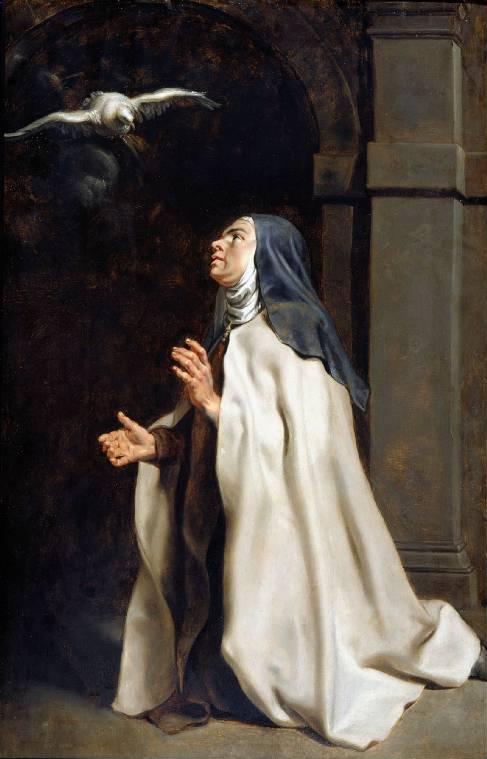

Teresa of Ávila Teresa de Jesús
Teresa Sánchez de Cepeda y Ahumada
The Discalced Carmelite reformer, mystical writer, and Doctor of the Church whose Interior Castle (1577) and broader theological corpus produced the most systematic articulation of contemplative-mystical theology in the Christian tradition. Co-founder with John of the Cross of the Carmelite reform; first woman declared a Doctor of the Church (1970).
Teresa of Ávila (Teresa Sánchez de Cepeda y Ahumada, in religion Teresa de Jesús, 1515-1582) is the Discalced Carmelite reformer, mystical writer, and Doctor of the Church whose principal work El Castillo Interior (the Interior Castle, 1577) produced the most systematic articulation of contemplative-mystical theology in the Christian tradition. Co-founder with John of the Cross (1542-1591) of the Discalced Carmelite reform, Teresa established seventeen reformed monasteries across Castile during her lifetime against substantial ecclesiastical and political opposition. Canonized in 1622 (with Ignatius of Loyola, Francis Xavier, Philip Neri, and Isidore the Laborer in the most famous canonization of the Counter-Reformation), Teresa was declared Doctor of the Church by Pope Paul VI in 1970 — the first woman so declared, with Catherine of Siena receiving the honor the same year.
Intellectual biography
Teresa was born in 1515 in Ávila, the walled Castilian city, to Don Alonso Sánchez de Cepeda (a wealthy textile merchant) and Beatriz Dávila y Ahumada (his second wife). The family was substantial in Ávila’s social-economic life; the documented complexity of Teresa’s heritage includes her grandfather Juan Sánchez de Toledo, a Toledan Jew converted to Christianity under duress in the 1480s — a converso heritage that became increasingly important to twentieth- century Teresa scholarship as the limpieza de sangre (purity of blood) culture of sixteenth-century Spain made the conversa background a complicated inheritance for Teresa’s family. The substantial recent scholarship (Teófanes Egido, Jodi Bilinkoff, Carlos Eire) has established the documentary basis for the conversa heritage and explored its significance for Teresa’s spiritual development.
Teresa entered the Carmelite Convent of the Incarnation in Ávila in 1535 at age twenty against her father’s wishes. The Convent of the Incarnation in Teresa’s day operated under the mitigated Carmelite Rule (the relaxed discipline that had developed in the late medieval period) with substantial relaxation of the original austere observance. Teresa took her vows in 1537 but suffered severe illness through her early religious life, including periods of paralysis and prolonged convalescence. The decisive transformation of her interior life occurred in 1554 — Teresa was thirty-nine — when, kneeling before an image of the wounded Christ, she experienced what she would later describe as the beginning of her sustained contemplative-mystical life. The mystical experiences intensified across the next decade.
Beginning in 1562 Teresa undertook the Discalced Carmelite reform: the restoration of the original austere Carmelite Rule (poverty, enclosure, manual labor, sustained contemplative prayer) against the mitigated practice that had developed. Her first foundation was San José in Ávila in 1562; over the next twenty years she founded sixteen additional reformed monasteries (mostly female, with the male Discalced Carmelite establishments founded with John of the Cross beginning in 1568). The reform met sustained ecclesiastical and political opposition; Teresa was investigated by the Inquisition multiple times, and the larger-scale political conflicts between the Discalced and Calced (Mitigated) Carmelite branches led to substantial institutional disruption through the 1570s.
Teresa wrote her principal works in this period: the Vida (autobiographical Life, 1562-1565), the Camino de Perfección (Way of Perfection, 1566), the Libro de las Fundaciones (Book of the Foundations, 1573-1582), and most significantly the Castillo Interior (Interior Castle, 1577). She died on October 4, 1582 — actually October 15 in the Gregorian calendar, since the Gregorian reform of the calendar took effect during her death — at Alba de Tormes in Castile.
Key contributions
The Interior Castle (Castillo Interior, 1577) is Teresa’s principal work and one of the most consequential single works in the history of Christian mystical theology. The work presents the soul as a castle of seven dwelling places (moradas) traversed progressively inward toward the divine center; the contemplative practitioner moves through the dwellings in a sustained development that organizes the entirety of the contemplative-mystical life. The first three dwellings cover the active stages of the spiritual life; the fourth introduces the supernatural-contemplative dimension; the fifth, sixth, and seventh dwellings articulate the increasingly deep stages of mystical-experiential transformation, with the seventh representing the spiritual marriage between the soul and Christ. The work was composed in approximately six months in Toledo and Ávila, under instruction from her confessor and at the request of her sisters after the Inquisitorial seizure of the Vida had restricted that earlier autobiographical work’s circulation.
The Vida (Life, 1562-1565) is the autobiographical account of her contemplative development. Composed at the direction of her confessors as a record for ecclesiastical evaluation, the Vida is both autobiography and mystical-theological treatise. The Inquisition seized it in the late 1570s following accusations of alumbradismo (Illuminism, the heretical contemplative-spiritual movement); the work was returned and continued to circulate but was not formally published until after Teresa’s death.
The Camino de Perfección (Way of Perfection, 1566) is the practical-pastoral treatise on contemplative prayer addressed to her Carmelite sisters. The work covers the foundational Carmelite-Discalced practice of mental prayer, with substantial attention to the practical-spiritual difficulties the practitioner encounters and the ways the Carmelite community-life supports the contemplative formation.
The organizational achievement of the Discalced Carmelite reform itself is a substantial contribution distinct from her textual corpus. The seventeen reformed monasteries Teresa founded, the institutional infrastructure she established, and the partnership with John of the Cross that produced the parallel male Discalced Carmelite tradition together constitute one of the most successful Catholic-religious-reform projects of the sixteenth century. The Discalced Carmelite Order continues as a substantial worldwide religious community to the present.
Key controversies
The conversa identity is the principal contemporary scholarly issue. The substantial recent scholarship (Egido, Bilinkoff, Carlos Eire, others) has established Teresa’s converso paternal heritage and explored its complex significance. Whether and how the conversa background shapes Teresa’s spiritual formation, theological vocabulary, and the architecture of inwardness in the Interior Castle remains an open scholarly question. The relationship between the marrano/converso experience of inner faith concealed behind external conformity and Teresa’s sustained articulation of inwardness as the foundational contemplative register has been treated suggestively without reaching the threshold of documented influence.
The visionary-versus-doctrinal reading is the principal interpretive issue within the corpus itself. Is the Interior Castle primarily a visionary report (Teresa describing what she actually experienced in mystical prayer) or a doctrinal treatise (Teresa using the visionary frame to teach a method of contemplative progression). The two readings are not exclusive but produce different texts. The Carmelite tradition has tended toward the doctrinal reading; the literary-critical and feminist-theological readings of the late twentieth century (Rowan Williams, Caroline Walker Bynum, Catherine Mooney, others) have recovered the visionary register and the gender-political dimension of Teresa’s claims to spiritual authority.
The Inquisitorial investigations are the principal historical-political issue. Teresa was investigated multiple times during her career, on charges ranging from alumbradismo (Illuminism) to crypto-Jewish practice (a charge that would have invoked the limpieza de sangre concerns about her converso heritage) to general suspicion of female mystical authority. The investigations did not produce condemnation in any case, but they shaped Teresa’s writing substantially: the Vida and the Castillo Interior were both composed under substantial awareness of Inquisitorial scrutiny, and the strategic use of self-deprecating language and the careful submission to ecclesiastical authority operates as a defensive register throughout her work.
The gender-political question is a continuing scholarly issue. Teresa operated within sixteenth-century Spanish Catholic structures that severely constrained women’s authority; her sustained spiritual-organizational achievement required substantial negotiation of those constraints. Her writing explicitly addresses the question: she is aware that her very capacity to write about contemplative theology is itself contested. The contemporary feminist-theological recovery has been substantial; Rowan Williams’s Teresa of Avila (1991) and the broader contemporary scholarship treat Teresa as a substantive systematic theologian whose work merits direct theological engagement rather than hagiographic piety.
Transmission received
Teresa inherits the Spanish recogimiento tradition of contemplative prayer, particularly through Francisco de Osuna’s Tercer Abecedario Espiritual (Third Spiritual Alphabet, 1527), which she identifies in the Vida as the text that introduced her to mental prayer. The recogimiento tradition descends from late-medieval Iberian Christian contemplative practice and sits within the broader Western Christian apophatic tradition descending from Pseudo-Dionysius through the Rhineland mystics. Augustine’s Confessions and the broader patristic-Augustinian tradition shape the autobiographical-confessional register of the Vida. Bernard of Clairvaux and the Cistercian-affective tradition shape the bridal-mystical register that operates throughout the Castillo Interior.
Transmission given
John of the Cross (1542-1591) is Teresa’s closest intellectual partner and the principal articulator of the apophatic complement to her largely kataphatic Castillo. The two writers together produce the most complete account of the Christian mystical path available in any tradition: Teresa’s seven moradas articulate the structured kataphatic ascent; John’s Subida del Monte Carmelo and Noche Oscura articulate the apophatic stripping. See the Apophatic Christian codex for the full Carmelite- synthesis context.
The post-Teresa Discalced Carmelite tradition continues through her substantial institutional legacy. The principal twentieth-century Carmelite figures — Thérèse of Lisieux (1873-1897), Edith Stein (1891-1942) — operate within the Discalced Carmelite framework Teresa established. Hans Urs von Balthasar and the broader twentieth-century Catholic theological recovery treat Teresa as a substantive systematic theologian rather than as a “merely” visionary writer.
The contemporary scholarly reception is extensive. Edith Stein’s mid- twentieth-century engagement (Stein converted to Catholicism, entered the Discalced Carmelite Order as Teresa Benedicta of the Cross, and wrote substantially on Teresa before her death at Auschwitz). Rowan Williams’s Teresa of Avila (1991) is the foremost contemporary Anglican-theological treatment. Carlos Eire’s From Madrid to Purgatory (1995) and adjacent historical-religious scholarship establish the Counter-Reformation Spanish context. Jodi Bilinkoff’s The Avila of Saint Teresa (1989) provides the foundational social-historical-religious context.
The standard scholarly translation is Kavanaugh and Rodriguez’s Collected Works of St. Teresa of Avila (ICS Publications, 1980). Hekhal hosts the public-domain E. Allison Peers 1946 translation of the Castillo Interior. The standard Spanish critical edition is the Tomás Álvarez edition (Editorial Monte Carmelo, multiple volumes).
For the corpus’s institutional and theological context, see the Apophatic Christian codex. For the cross-tradition parallel through the architectural figure of the soul, see the map-of-the-interior triangle. For the Palace Ascent reading path, the Castillo Interior sits as the late corner of the three-tradition reading sequence.
- The Interior Castle · Las Moradas · The Dwelling Places · 1577 · Toledo and Ávila, Castile
Stable URLs are part of the editorial commitment. This address will not change.
Hekhal Editorial. "Teresa of Ávila." Hekhal: An Open Reference for Esoteric Tradition. Last modified May 2, 2026. https://hekhal.org/figures/teresa-of-avila.
Hekhal Editorial. 2026. "Teresa of Ávila." Hekhal: An Open Reference for Esoteric Tradition. https://hekhal.org/figures/teresa-of-avila.
Hekhal Editorial. "Teresa of Ávila." Hekhal: An Open Reference for Esoteric Tradition, May 2, 2026, hekhal.org/figures/teresa-of-avila.
Hekhal Editorial. (2026). Teresa of Ávila. Hekhal: An Open Reference for Esoteric Tradition. https://hekhal.org/figures/teresa-of-avila
@misc{hekhal-figures-teresa-of-avila-2026,
  author       = {{Hekhal Editorial}},
  title        = {{Teresa of Ávila}},
  year         = {2026},
  publisher    = {{Hekhal: An Open Reference for Esoteric Tradition}},
  url          = {https://hekhal.org/figures/teresa-of-avila},
  urldate      = {[date accessed]}
}